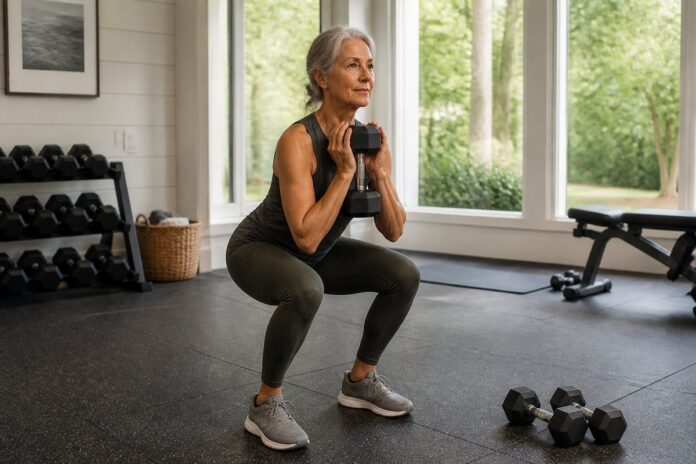
Staying strong in your 60s is about more than looking fit — it can help support independence, balance, posture, and long-term bone health. According to the report, trainer Patricia Greaves, CPT, selected six strength exercises that focus on the movement patterns women need most as they get older, from lifting and squatting to pulling and stabilizing the core.
The idea is to train the body for everyday demands, such as carrying groceries, getting up from the floor, or recovering if you lose your footing. The exercises are meant to work together as a practical strength routine, and the report notes that it is never too late to begin building a foundation, whether someone starts in their 20s, 30s, 60s, or beyond.
The six-move routine
The lineup includes a goblet squat, bent-over row, jump squat, dead bug, side plank, and single-leg balance with a toe touch. Each move targets a different part of fitness: the goblet squat emphasizes legs, core, mobility, and load-bearing strength; the bent-over row focuses on upper-back and shoulder strength for pulling tasks and posture; and the jump squat adds a plyometric challenge that can help with power and bone-loading work.
The remaining exercises bring in core control and stability. The dead bug is included as a way to train the deep abdominal muscles and support safer movement mechanics, while the side plank works the obliques and helps build trunk stability. The single-leg balance with toe touch is designed to challenge coordination and balance, which become increasingly important for injury prevention and everyday function. The report says the exercises can be added to a weekly strength routine or done together as a circuit for 8 to 12 reps each, repeated two to three times with rest as needed.
Greaves, who founded StrongHer Personal Training and works as a menopause fitness specialist, is highlighted in the report as someone who coaches women in their 40s, 50s, and beyond. The overall message is straightforward: strength training can remain a valuable part of fitness at any age, and these movements offer a structured way for women in their 60s to keep building resilience.
Source: womenshealthmag.com